Asian Therapist for Burnout, Shame, Guilt, and Generational Trauma
For people who keep everything running, keep going on empty, and can't rest without feeling they have to earn it.
Therapy that honors your nervous system, identity, and inner resilience
About me
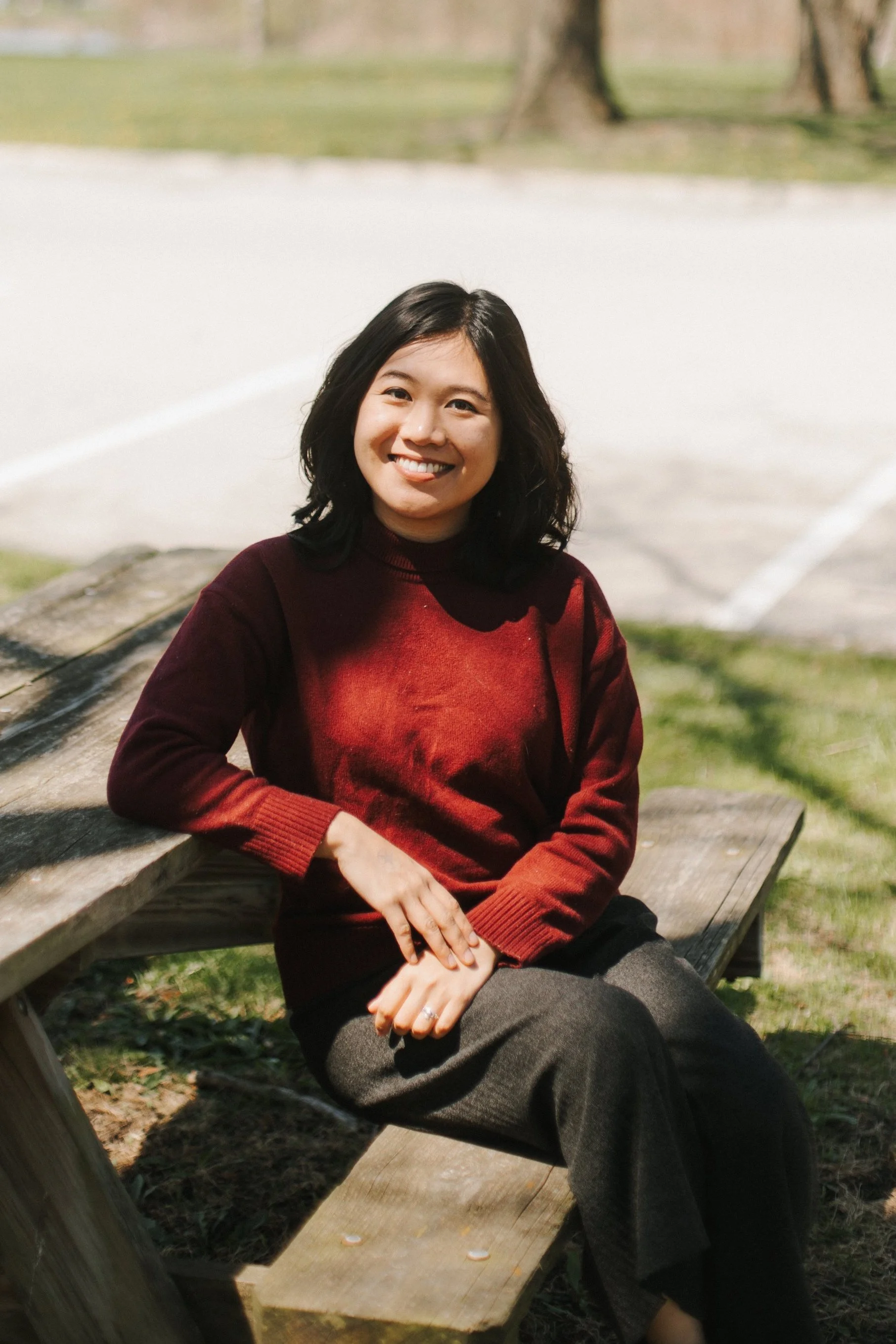
My name is Tsuki Niu 梁子祈, the name I was given in my mother tongue, Taiwanese. My legal name in Mandarin is Tzu-Chi Liang. I’m a cisgender, bisexual woman in my 30s, able-bodied, highly sensitive, and 1/4 Indigenous.
I grew up in Taiwan in a middle-class Christian family where the church was a central part of life. That upbringing rooted me in community care and social justice, but it also came with pressure to succeed, to conform, and to hide the parts of myself that didn’t fit the mold.
Like many of my clients, I internalized messages about discipline, morality, and productivity, messages that left little space for rest, play, emotional expression, or reclaiming my sexuality. I learned to carefully show only the parts of me that felt safe enough to be seen.
I moved to the U.S. in the midst of a global pandemic and racial justice uprisings. Those years were disorienting and heavy, but also deeply liberating. I found space to ask deeper questions about identity, belonging, and the parts of myself I had long kept quiet. I began to hold compassion for the urgency and shame I had learned so well, and slowly to unlearn them.
The process of questioning, learning and unlearning, and re-understanding still continues today. As I navigate life as a first-generation immigrant, move through different chapters of life, engage in ongoing training, and sit with clients whose stories echo and expand my own, these experiences shape who I am, and also how I show up in the therapy room.
Professional Experience
-
In Taiwan, my early career was rooted in social work within child protection and domestic violence prevention systems.
I worked with government and nonprofit programs supporting children and adolescents navigating domestic violence, sexual exploitation, and juvenile justice involvement. These experiences shaped my understanding of how deeply children’s lives are influenced by family dynamics and broader social systems. I often saw how young people were expected to change while the environments shaping them remained unexamined.
This also led me to pursue training in couple and family therapy, where I could better understand emotional and relational patterns and develop a systemic lens for working not only with individuals, but with the relationships and larger systems that shape their experiences.
-
During my clinical training in couple and family therapy in the United States, I worked with individuals, couples, and families from trauma-informed, relational, and systemic perspectives.
My work included supporting clients navigating identity development, relational conflict, emotional distress, trauma recovery, and the intersection of sexuality, spirituality, neurodivergence, and culture. I also received training in play therapy, couple and family therapy, and sex therapy.
Over the years, I have worked with people from diverse backgrounds, including neurodivergent clients, gender, sexuality, and relationship diverse communities, and multicultural couples and families.
The systemic and social justice oriented lens continues to shape how I approach therapy today, especially when working with clients navigating shame, cultural expectations, and complex family dynamics.
Credentials & Licensure
-
MS in Couple and Family Therapy, Purdue University Northwest
Bachelor of Social Work, Tunghai University, Taiwan
Licensed Marriage and Family Therapist (LMFT)
Licensed in IL, IN, MI, WI, OR, WA, and MA
Certified Social Worker, Taiwan
-
Internal Family Systems (IFS) – Level 1 Trained
Grounded in ongoing personal inner work, training, and clinical consultation
-
Gottman Method Couples Therapy – Level 2 Trained
Emotionally Focused Couples Therapy (EFCT)
-
Registered Play Therapist™ (RPT)
Certified AutPlay® Therapy Provider
Certificate in Child-Centered Play Therapy (CCPT) with Neurorelational Emphasis
Infant/Early Childhood Mental Health Consultant (I/ECMHC) – Illinois
Trauma-Focused Cognitive Behavioral Therapy (TF-CBT)
-
Polyvagal-Informed Practitioner
Training through the Polyvagal Institute. While there is no formal certification, I draw on polyvagal-informed ideas.Sex Therapy
Completed the training and supervision hours required for AASECT sex therapist certification. I did not apply for certification.
What Guides My Work
I don't believe in quick fixes or pathologizing your pain.
Healing is relational and rooted in reclaiming your story, not shrinking it.
Below are some of the values that guide my work.
Learning, unlearning, and acting on what I learn don't have an end point.
For me that has meant books, museum exhibits, courses, supervision, and consultation, with no fixed schedule.
These are values I practice and keep learning about, not a list of specialties.
-
Holding space for the complexity of multiple, layered identities and lived experiences, acknowledging how they shape access, privilege, and oppression.
I honor both where you come from and who you’re becoming.
Learning about your world is my responsibility, not something you have to carry. I’m also curious, and whatever you choose to share, I’d love to learn from you.
-
Honoring Gender, Sexuality, and Relationship Diversity (GSRD) by welcoming all expressions, identities, and configurations.
I hold deep respect for each client's unique story, including culturally, spiritually, and historically rooted understandings of gender, sexuality, and relationships, beyond Western frameworks or labels. All of you are welcome here.
-
I am committed to ongoing learning and co-creating flexible, non-pathologizing spaces that honor diverse ways of thinking, feeling, and being, without expecting clients to mask or conform. Access is a matter of justice, not a favor, and it shouldn't depend on a diagnosis or proof.
-
Believing that rest, care, and acceptance are not things anyone has to earn through achievement, usefulness, or endurance, and questioning the capitalism and ableism that measure a person by what they produce.
Exhaustion is real and personal, and it is also shaped by those systems.
-
Supporting each person in reclaiming their voice, boundaries, and power, with deep respect for self-determination. Power in therapy is uneven, and I would rather name that than pretend otherwise.
-
Believing that sex, pleasure, and bodies are part of being human and nothing to be ashamed of. A body is not a problem to shrink. I question the standards that taught us how bodies should look and what we are allowed to want, and the shame that has come with them.
-
Understanding that mental health cannot be separated from social, political, and historical context, including the impact of personal, collective, and intergenerational trauma and systemic inequities, and working to name and address those layers with care.
-
Standing against the ways racism decides who gets care, safety, and rest, including anti-Blackness, anti-Asian racism, and the model minority myth, which has been used to deny racism and to set communities against each other. I stand for Black liberation and for reparations as material repair, not only acknowledgment.
Indigenous sovereignty and Land Back are part of this too: see Land, Labor & Accountability.
-
I am located on the stolen ancestral homelands of the Peoria, Bodwéwadmi (Potawatomi), Hoocąk (Ho-Chunk), Kiikaapoi (Kickapoo), Myaamia, and Očhéthi Šakówiŋ peoples, who have stewarded these lands since time immemorial. I honor their enduring presence and sovereignty, and hold deep respect for the histories, cultures, and lives that were violently disrupted through forced removal and ongoing colonial violence.
I recognize that this land and this nation were built through the exploitation of enslaved and trafficked African peoples. I honor the lineages of Black people whose lives and labor were taken, and I hold this history as part of my ongoing learning, one that shapes how I understand healing, power, and care.
As a Taiwanese immigrant, I am a settler on this land. My grandmother is Pazeh/Kaxabu, one of Taiwan's Indigenous peoples. Taiwan has its own 400-year colonial history and its own ongoing Land Back movement. It's a reminder that dispossession, erasure, and Indigenous resistance are not singular to any one place.
I give to Indigenous-led organizations when I can, buy from Indigenous-owned businesses, and share their calls to action. I go to marches, attend events led by Indigenous communities, and learn the history of the land I live on.
I hold my positionality on this land with humility, and I remain committed to learning what it means to be accountable here, in this place, on this land. I advocate for Land Back, Indigenous sovereignty, and reparations, and I am committed to doing this work within the mental health field, questioning the colonial and capitalist frameworks embedded in how we understand healing, pathology, and care.
-
Believing that safety and care can be built without policing, punishment, or confinement, including immigration detention, and questioning how mental health systems themselves have taken part in that harm.
-
Standing against genocide wherever it happens, including against Uyghur, Rohingya, and Yazidi peoples and in Gaza, Sudan, Congo, and Tigray, and in solidarity with global movements for justice, human rights, and dignity for all people across all borders.
-
Valuing collective care and relational healing as core parts of well-being. Not everything you carry is yours to work out alone, and therapy is only one piece of what holds a person up.